Ocean air is wonderful for beach days, but it can be tough on outdoor equipment. If you own in Wainscott, you want heating and cooling that feels effortless, runs quietly, and stands up to salt, wind, and occasional flooding. The good news: today’s cold-climate heat pumps can deliver comfortable, year-round performance on the South Fork when they’re chosen and installed the right way. In this guide, you’ll learn which systems work best here, how to place them on coastal lots, what specs and permits to check, and the incentives that can help. Let’s dive in.
Wainscott’s coastal climate and why it matters
Wainscott enjoys relatively mild winters compared with inland New York, with ocean-moderated temperatures and humid summers. That means a well-chosen heat pump can cover most heating hours and all of your cooling. Use units designed for the Northeast’s colder snaps, not tropical-only models. Look for cold-climate ratings that verify low-temperature performance and efficiency, and use local climate normals as your reference point from nearby coastal stations like Montauk and East Hampton. NOAA’s climate normals provide helpful context.
Key takeaway: Choose cold-climate models listed by respected regional programs for the Northeast. NEEP’s cold-climate product list and guidance are strong baselines for what works here. Review info on NEEP’s ccASHP criteria and product list.
Heat pump options that shine on the South Fork
Ductless mini-splits
- Pros: Minimal disruption during install, great for additions, guest suites, and targeted comfort. Many models offer coastal coatings.
- Cons: Multiple indoor heads can add cost; whole-home distribution may be better with a central system in larger homes.
Ducted central air-source heat pumps
- Pros: Leverages existing ductwork, delivers even, whole-home comfort, and is available in cold-climate models. Ideal when replacing central AC or a furnace.
- Cons: Requires sound ductwork. If ducts are leaky or uninsulated, you may lose efficiency. See selection and sizing basics in this cold-climate sizing guide.
Cold-climate multi-split and VRF
- Pros: Excellent low-temperature performance with strong capacity at 5°F when properly sized. Great for electrification of primary heat in coastal NY. Verify models against NEEP’s guidance.
- Cons: Higher upfront cost and more complex design.
Ground-source geothermal
- Pros: Very high efficiency and stable performance with long equipment life. Works well on larger parcels with room for ground loops.
- Cons: Highest installation cost and more permitting/site coordination.
Hybrid or dual-fuel
- Pros: Pair a heat pump with an existing oil or gas system. Use the heat pump for most days, then rely on backup heat only during rare deep freezes.
- Cons: More components and controls to manage.
Coastal installation that lasts
Corrosion defense
Salt-laden air accelerates corrosion even a few miles inland. Specify coastal packages with coated coils, powder-coated cabinets, and stainless hardware, and confirm the warranty covers seacoast use. Manufacturer coastal packages, such as the Modine Coastal Coat, illustrate what to ask for. Learn what those treatments include from this overview of a coastal protection package.
Flood and surge readiness
If your site lies in or near a mapped flood zone, plan to elevate outdoor units above the Base Flood Elevation and anchor platforms to handle wave and wind forces. Permits may require details on elevation, anchoring, and service access. Start early by reviewing FEMA’s guidance and confirming your parcel’s floodplain status. See FEMA Building Science resources on protecting mechanicals from flood damage: FEMA publications.
Wind, anchoring, and service access
Coastal storms bring wind and debris. Ask your installer to bolt equipment to rated platforms, use flexible connections, and design service clearances that allow coil washing. Proper anchoring reduces vibration and protects refrigerant and electrical lines.
Quiet placement on tight lots
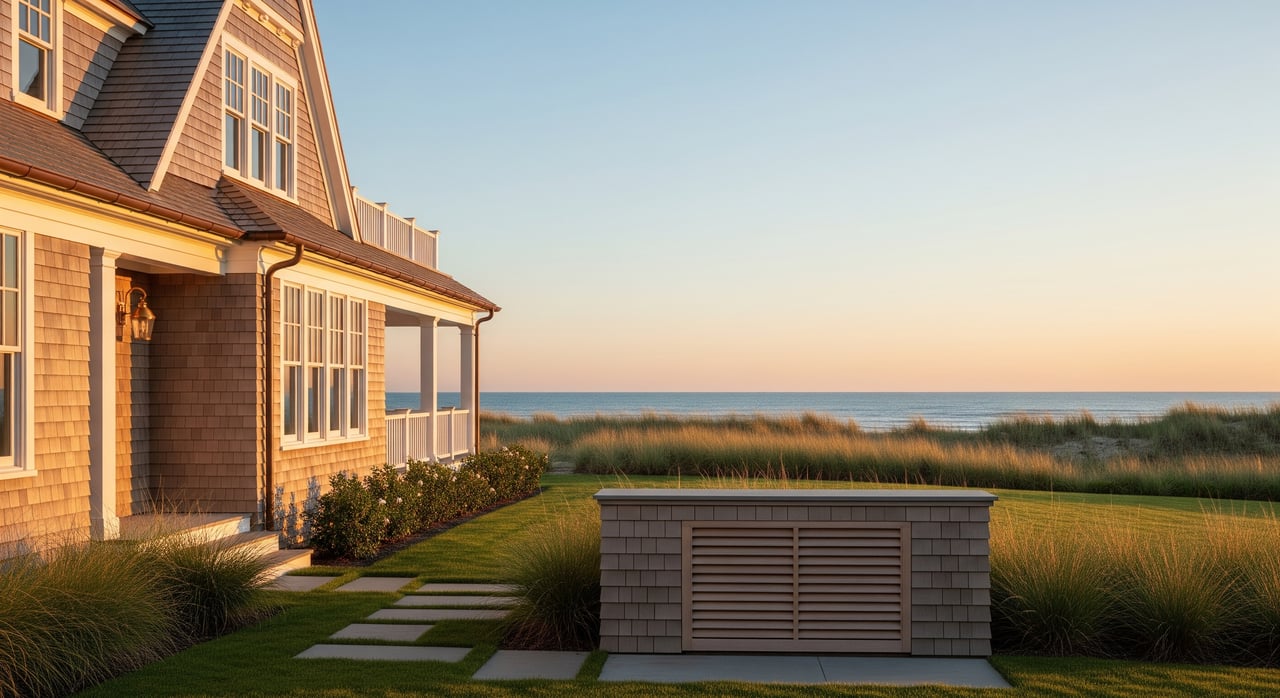
Most modern heat pumps are comparable to newer AC units in sound. Place outdoor units away from bedroom windows and neighboring patios when possible, and consider anti-vibration pads. Verify any Town of East Hampton placement or noise rules during permitting.
Performance, sizing, and cost essentials
The metrics that matter
- HSPF2 and SEER2: Newer seasonal efficiency metrics used in many rebates and codes. Higher numbers mean better efficiency. See this technical guide to selection and sizing.
- Capacity and COP at 5°F: These numbers show how well a unit will heat during cold snaps. Favor models that retain strong capacity at low temperatures, such as those meeting NEEP’s cold-climate criteria.
Right-size with Manual J
Insist on a room-by-room Manual J load calculation before selection. It helps avoid oversized or undersized systems and is often required for rebates. PSEG Long Island’s programs frequently require Manual J and cold-climate qualified equipment for full incentives. Check current requirements on the PSEG Long Island rebates page.
Operating cost basics
Heat pumps move heat rather than create it, so they can cut heating energy use compared with electric resistance and often reduce costs versus oil or propane, depending on rates. Your actual cost depends on your home’s heat loss, your unit’s efficiency, and PSEG Long Island’s $/kWh. Learn the fundamentals from Energy.gov’s home upgrades guide.
Plan for rare cold snaps
Modern cold-climate systems still provide useful heat in single digits. If you want extra resilience, a dual-fuel setup or integrated electric backup covers the rare extremes without sacrificing everyday efficiency.
Incentives, permits, and paperwork
Federal tax credits
The Energy Efficient Home Improvement Credit has offered a credit for qualified heat pumps, typically 30 percent of eligible costs up to an annual cap for heat pumps. Keep itemized invoices and manufacturer documentation, and confirm current-year IRS rules before filing. Start with the IRS page for the Energy Efficient Home Improvement Credit.
New York and PSEG Long Island rebates
Income-eligible homeowners may qualify for NYSERDA’s EmPower+ incentives that can significantly reduce project costs. Review details for eligibility and program steps at NYSERDA EmPower+. PSEG Long Island’s Home Comfort programs offer tiered rebates for ducted and ductless systems and often require participating contractors, Manual J documentation, and qualifying equipment. See current tiers and rules on PSEG Long Island’s rebates page.
Permits and documentation to request
- Building permits: Your installer should handle electrical and mechanical permits. In mapped floodplains, expect elevation details and possible floodplain review.
- Proof points: Manual J and Manual S reports, spec sheets with HSPF2/SEER2 and capacity at 5°F, and confirmation that your model meets regional cold-climate criteria, such as those highlighted by NEEP.
- Warranty and service: Put coastal corrosion protection and maintenance plans in writing.
Your Wainscott heat pump checklist
- Get a home energy audit and a Manual J before choosing equipment.
- Select cold-climate models and verify low-temperature capacity and COP at 5°F.
- Specify coastal protection: coated coils, stainless fasteners, and documented seacoast warranty.
- Check flood maps and elevate or flood-proof outdoor units where needed; anchor for wind.
- Use participating contractors for rebates and confirm who submits all paperwork.
- Keep invoices, model numbers, load calculations, permits, and rebate documents in one file.
Ready to align comfort, resilience, and long-term value in your Wainscott home? If you are planning a renovation or preparing to sell, we can help you prioritize upgrades that stand up to coastal conditions and resonate with Hamptons buyers. Reach out to Nicole Tunick for discreet, expert guidance.
FAQs
Do heat pumps really work in coastal Long Island winters?
- Yes. Cold-climate models are engineered to deliver efficient heat through most winter conditions here. Focus on units that list strong capacity and COP at 5°F, and size the system with a Manual J.
How should I place a heat pump on a flood-prone lot?
- Elevate the outdoor unit above the local Base Flood Elevation, anchor the platform for wind and water forces, and maintain clear service access. Your installer should coordinate these details during permitting.
What efficiency specs should I compare when shopping?
- Look for HSPF2 and SEER2 for seasonal efficiency, plus the rated heating capacity and COP at low temperatures. These metrics reveal how the unit performs during cold snaps.
What incentives are available for Wainscott homeowners?
- Many projects can combine the federal Energy Efficient Home Improvement Credit with PSEG Long Island rebates, and income-eligible households may qualify for NYSERDA’s EmPower+ support. Program rules and amounts change, so confirm current requirements before you buy.