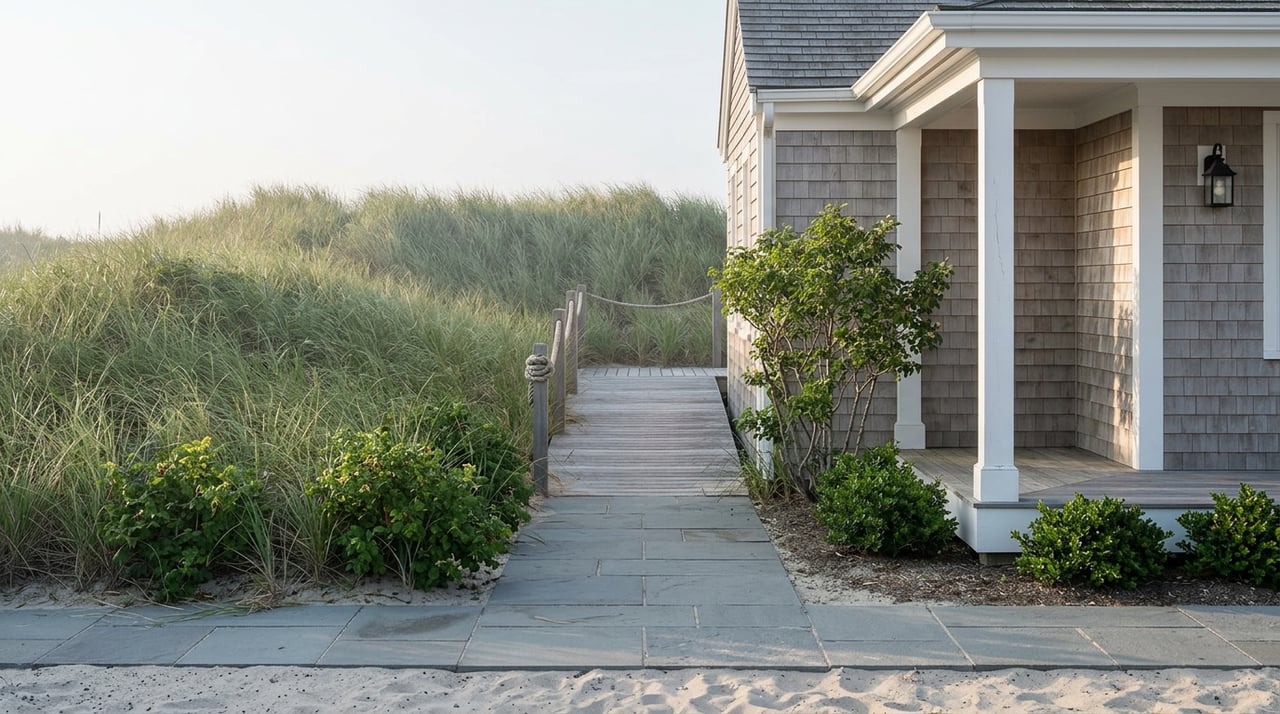
On a Saturday in the middle of August, Wainscott Beach has maybe a dozen people scattered across it. A fifteen-minute drive east, Main Beach in East Hampton Village fills in by mid-morning, towels edge to edge. Same ocean, same sand, same summer. The gap between the two isn't luck. It's a set of small, deliberate frictions that most people who live here have absorbed without ever naming them, and once you see how they fit together, the quiet stops looking accidental.
Why the Beach Stays Empty
Wainscott Beach and its neighbor to the west, Town Line Beach, both require a Town of East Hampton parking permit, and neither has a lifeguard on duty. No lifeguard means swimming is technically off-limits at both beaches, even in the height of summer. That single administrative fact does more to shape the crowd than any amount of natural beauty. People who want a supervised swim drive to Main Beach or Georgica Beach, where lifeguards work, and people who want a long walk on open sand without a line for parking end up here. Town Line Beach allows drive-on access with a town permit, which draws a slightly different crowd again, but the basic mechanism is the same at both spots: park with a permit, walk, don't swim, and the beach stays yours.
That absence of supervision doesn't register as a loss to the people who actually use these beaches. A lifeguard chair means staffing, means posted hours, means a beach built around watching people swim. Wainscott's beaches were never built that way, and the missing infrastructure is exactly what keeps them from turning into Main Beach.
A Pond That Only Opens Twice a Year
Wainscott Beach sits right up against Georgica Pond, a 290-acre lagoon that separates itself from the Atlantic behind a shifting sandbar. What most visitors don't realize, and what most residents only half-remember until it comes up again, is that the pond doesn't stay closed. The East Hampton Town Trustees manage a cycle of opening it to the ocean roughly twice a year, in mid-March and mid-October, to flush out sediment and regulate the water level. The tradition goes back to the 1600s, when the opening was dug by hand. Heavy equipment does it now, but the calendar hasn't changed.
That twice-yearly rhythm is why the pond's character shifts through the year. It runs brackish, mixing spring water and groundwater with ocean water whenever it's open, and its salinity swings depending on where the pond sits in that cycle. Anyone planning to kayak or paddleboard from the rest stop near Beach Lane is really planning around a schedule the Trustees set, not the weather. The closest public access to the pond itself is at Beach Lane, again by town permit, and given the pond's history of algae blooms, it's worth checking the New York State Department of Environmental Conservation's harmful algae bloom notifications before wading in, not because the pond is unusually risky but because its condition genuinely changes with the calendar.
The Sidewalk That's Taken Seven Years and Counting
If the beach and the pond show how natural rhythms and old permit rules quietly manage the hamlet's edges, the business district shows how the same instinct plays out in slow motion downtown. Wainscott's hamlet plan was adopted into the East Hampton Town comprehensive plan back in 2019, and one of its central goals was making Montauk Highway walkable between the businesses that already sit along it. Seven years later, that goal is still mostly on paper.
In July 2024, a trio of planning consultants told the town board to stop trying to solve the whole plan at once and instead focus on what Carolyn Logan Gluck, chair of the Wainscott Citizens Advisory Committee, called the "SAT approach": handle the easy questions first, then circle back to the hard ones. The easy question, in this case, is roughly 4,000 linear feet of streetscape between West Gate Road and Hedges Lane. The hard question is what to do with the Wainscott Commercial Center, a 70-plus-acre former sand and gravel pit that Logan Gluck has called "the elephant in the room," and whose future is tangled up with unresolved questions about East Hampton Airport, which sits in the same hamlet.
In the meantime, walking Wainscott's commercial strip means crossing gaps that longtime business owner Pat Trunzo summed up plainly: he doesn't feel safe on foot until he reaches the sidewalk in front of HomeGoods, one of the only stretches with continuous pavement. The hamlet has money to work with. Wainscott was allotted $5.5 million from a host community agreement tied to the South Fork Wind Farm's transmission cable, which makes landfall here, out of $29 million the town received overall. Even with that funding identified, a 2022 planning poll had already flagged the priority as basic as finishing a continuous sidewalk, estimating $190,000 to replace roughly 1,120 linear feet, about a third of the commercial core. Progress since then has been the establishment of Wainscott Green, a small public space on the former site of the Swamp and Star Room nightclubs at the west end of the business district. It's a start. It is not yet a finish.
What Fills the Gaps
Against that unfinished backdrop, the businesses that do exist along Montauk Highway carry more weight than their small footprint suggests. The Seafood Shop has built its reputation on oysters, chowder, and a lobster roll that regulars order without looking at the menu. Levain Bakery draws a line for its oversized cookies most summer mornings. And every year, Bill and Lisa's Farm Stand opens for the season on the family's 24-acre Babinski farmstead, selling produce grown a few hundred feet from where it's sold. None of these places needed a finished streetscape plan to become fixtures. They filled the gaps the plan hasn't gotten to yet, which is its own kind of evidence that the hamlet's commercial identity was never really about infrastructure in the first place.
The Pattern, Once You See It
None of this is coincidence stacked on coincidence. A beach with no lifeguard stays quiet because the rules make it inconvenient for anyone chasing a supervised swim. A pond that opens on a fixed schedule shapes the entire season around it, whether or not anyone paddling across it that morning knows why the water tastes different than it did in April. A sidewalk that's been "almost funded" since 2019 keeps the business district feeling more like a scattering of destinations than a walkable village, which is exactly how some longtime residents prefer it and exactly what frustrates the people trying to change it.
Wainscott isn't quiet by accident. It's quiet because a permit system, a tidal calendar, and an unfinished civic plan all happen to point in the same direction. Understanding that mechanism doesn't change how the hamlet feels day to day, but it does explain why it feels the way it does, and why that feeling has held steady even as the money and the meetings pile up around it.
If you're weighing a move within Wainscott, or trying to understand how a property here fits into these same rhythms of beach access, pond cycles, and a business district still finding its shape, The Tunick Team spends its time in exactly these details. Request a Private Hamptons Consultation whenever you're ready to talk it through.