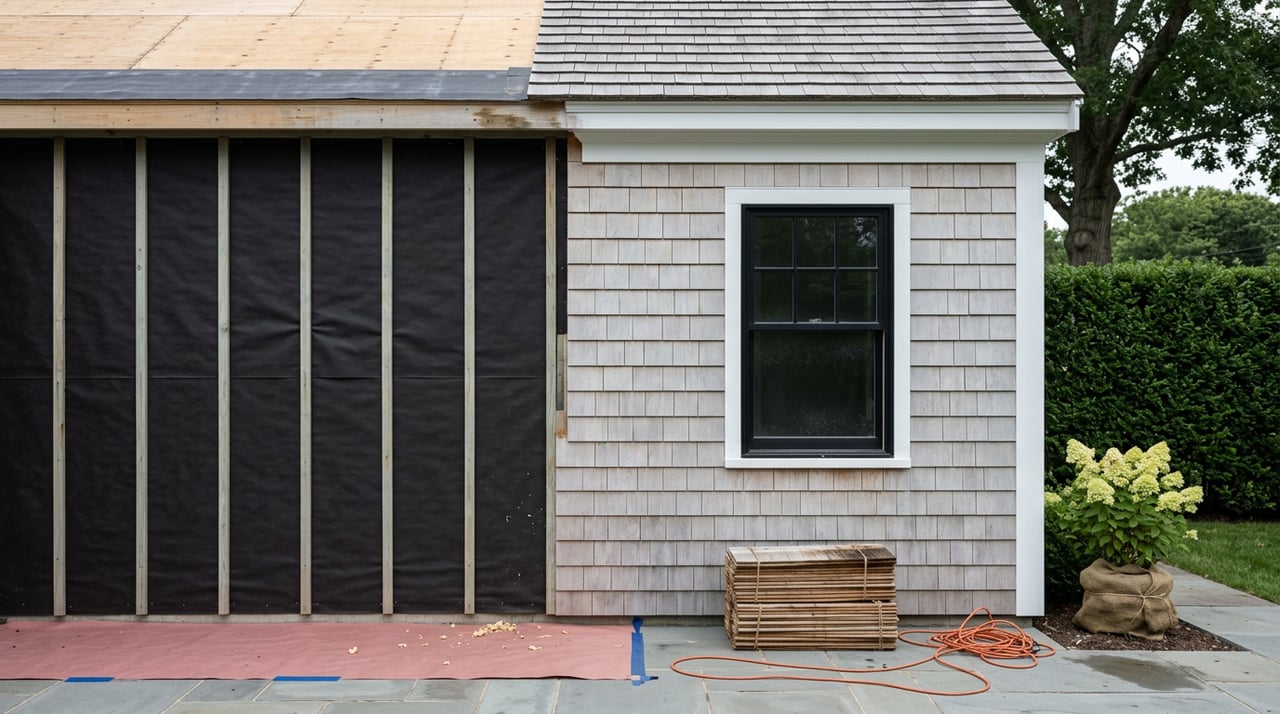
In February 2026, a home in the four-to-six-million-dollar range had already been sitting under contract for seven months. The builder who owned it was still paying to run it: utilities, landscaping, the pool. Not because the buyer had walked. Not because financing had fallen through. Because the paperwork was sitting inside a building department, waiting.
That builder was Neal Kurzner, who owns IQ Realty Management. "These issues cost us both time and money," he told the East Hampton Star. "We've had one home under contract since July, but because we still haven't been able to close, we've had to pay for whatever it costs to run a home: utilities, landscaping, the pool. I don't expect people to feel sorry for us, but it's not fair."
Kurzner's stalled closing was the visible edge of a longer-running story inside East Hampton's permitting system, and it still matters for anyone buying, selling, or building here in 2026. Not because the entire town is stuck. Because the size of the risk depends on a fact most buyers never think to check: whether the property sits inside the incorporated Village of East Hampton or in one of the unincorporated hamlets around it.
Two Departments, One Name
A listing that says "East Hampton" could mean the incorporated Village, with its own Village Hall, its own Building Department at 88 Newtown Lane, and its own Design Review Board overseeing four designated historic districts. Or it could mean Wainscott, Springs, Northwest Woods, Amagansett, or Montauk, all governed by the Town of East Hampton, with a separate building department and its own Architectural Review Board that reviews design against the town's colonial-heritage standards and its agricultural overlay district.
Two governments. Two staffs. Two sets of rules, operating under the same place name on a listing sheet. That split has always mattered for renovation timelines. In 2026 it matters for something more immediate: whether a closing happens on the date written into the contract.
What Six Months Actually Means
The Town of East Hampton's Building Department has spent close to a year working through a backlog that, as of a May 2026 report, stretched back to September 2025, according to reporting from 27east.com. Behind the delay: staff turnover, a handful of lawsuits, and a district attorney's bribery investigation that led to charges against two department employees.
In January 2026, the Star reported on a builder who had submitted a permit application at the end of July 2025 and still hadn't received it six months later, calling the complaint "typical." Town code itself sets a far tighter clock: the building inspector "shall approve or disapprove the application within a reasonable time, and in all events within 15 days," according to the town code language reported by the Star. By May 2026, town officials stopped disputing the gap. Asked directly how long an application submitted that week would take, public information officer Patrick Derenze said the town now estimates "that a fully completed application will take approximately six months to review," a figure confirmed in the Star's May 14, 2026 coverage of a town board meeting in Montauk.
Principal Building Inspector Richard Normoyle, who joined the department in September 2025 after 30 years in municipal building operations, has laid out a recovery timeline, according to 27east.com: cut the wait to three months by the end of 2026, then to four to six weeks by May 2027, with a two-week turnaround for smaller accessory permits. The department has also added staff: the town board hired Spanish-speaking building inspector Kelly Barros in May 2026, bringing the total to six new positions filled since the start of the year, per the Star's May 14, 2026 report. Separately, in January 2026 the board brought on an outside firm, Spaces Architecture, at an hourly rate up to $250 and not to exceed $30,000, to help clear stalled plan reviews, according to the Star's January 2026 coverage.
None of that had fully closed the gap as of the most recent reporting. In Amagansett, property owners Joseph Macari and Kim Staller filed a building permit application on December 24, 2025, for a home on Bendigo Road. By May 2026, having received no approval, denial, or request for additional documents, they filed an Article 78 lawsuit against the Building Department, according to the East Hampton Star. The property sits near the intersection of Bendigo Road and Cranberry Hole Road, stretching toward Napeague Bay, per 27east.com's coverage of the case.
The Rule That Got Paused
There is one piece of good news buried in this story, and it is easy to misread. In October 2023, the town adopted a code change requiring an updated Certificate of Occupancy before a property sale could close, originally set to take effect January 1, 2024. Facing the same backlog that has stalled new construction, the town board voted in March 2026 to pause enforcement of that requirement, with the stay extending through December 31, 2026, and applied retroactively to the original effective date, according to the Star's coverage of the vote.
In practice, that means a seller closing on a home with no open construction file right now likely will not be asked to produce an updated C.O. as a condition of sale. But the pause does not extend to construction projects that already require a building permit. If a property has an open permit for an addition, a pool, or new construction, that project still has to clear the same six-month queue before the certificate of occupancy tied to the finished work can be issued, and that certificate sits outside the enforcement pause entirely.
Village vs. Town, Side by Side
| Village of East Hampton | Town of East Hampton (unincorporated hamlets) | |
|---|---|---|
| Building Department | 88 Newtown Lane | As of February 2026, preparing to relocate to a new suite at 300 Pantigo Place |
| Design or historic review | Design Review Board, covering four historic districts, requires a Certificate of Appropriateness | Architectural Review Board, colonial-heritage design standards, agricultural overlay district |
| Statutory review clock | 60 days for a Certificate of Appropriateness decision, per Village code | 15 days for permit approval or disapproval, per town code |
| 2026 real-world wait reported | Not part of the backlog reporting covered here | Approximately six months, per the town's own May 2026 estimate |
Nothing in the reporting behind this piece points to a comparable backlog inside the Village's own building process. That is not proof one doesn't exist. It is a reason to ask rather than assume, especially since a property's mailing address rarely announces which government actually holds the file.
Before You Sign
- Confirm whether the property sits inside the incorporated Village or in the Town's unincorporated area, and identify which building department and design review board has jurisdiction over it.
- Ask whether there is an open building permit, plan review, or Certificate of Appropriateness application tied to the property, and request the application or file number rather than a verbal assurance.
- If any contingency in your contract depends on a completed inspection, a finished renovation, or an issued certificate of occupancy, build in more time than you would elsewhere on the East End, particularly for Town-jurisdiction properties.
- If you are selling, confirm whether your closing falls under the paused Certificate of Occupancy requirement, and if any portion of the property has open permitted work, get a direct answer about where that specific file sits in the town's queue before you set a closing date.
FAQ
Do I still need an updated Certificate of Occupancy to sell an East Hampton home in 2026? The town board's enforcement pause runs through December 31, 2026, and applies retroactively to January 1, 2024. If there is no open building permit tied to the property, you likely will not be required to produce an updated C.O. to close in the Town's unincorporated area right now. Properties with open, permit-requiring construction still need a certificate of occupancy for that specific work.
How do I find out if a property is in the Village or the Town? The simplest confirmation is to check with the appropriate building department directly, since the Village office at 88 Newtown Lane and the Town's office serve different areas and do not share a permitting queue.
Does the backlog affect a home that doesn't need any work? Not directly. The delay lives specifically inside open permit files. A home with no pending construction has no application sitting in the queue to hold up a closing.
Is the Village's historic district review facing the same delays as the Town? Nothing in the current reporting suggests it is. The Village's Design Review Board operates under a defined 60-day statutory window for Certificate of Appropriateness decisions in its four historic districts, a separate process from the Town's building permit backlog.
If you are weighing a purchase, a sale, or a renovation anywhere between Wainscott and Montauk, the jurisdiction question is worth answering before you fall in love with a floor plan. The Tunick Team tracks both sides of this line as part of every transaction we advise on. Request a Private Hamptons Consultation to talk through where a specific property stands before you write an offer or set a closing date.